| Home | Back to Goldfish |
The pearlscale is the commonest of the 'novelty' fantail derivatives in Britain, although it seems to be less often seen now than ten years ago. It breeds true to form, but it is a challenge to introduce the full suite of calico colours in addition to the orangey-white usually found. The pearlscale is a very lively fish, and is featured in our video (see About Us), nicknamed "golf ball" by the TV crew.
There is a long-finned version of the pearlscale, seldom seen in Europe.
Pearlscales first appeared in 1900.
The pearlscale standard is as follows:
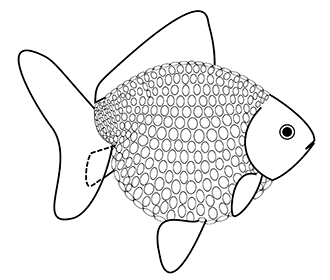
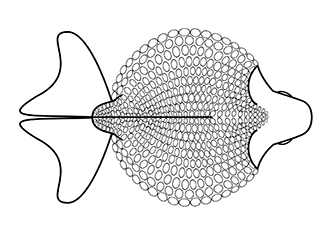
The fish should be bright and alert. The body should be short and rounded displaying well developed domed scales all over. The caudal fin should be well divided, forked and held high without drooping.
Metallic fish may be self-coloured (red, orange, yellow, blue, brown or black) or variegated (any combination of red, orange, yellow, blue, brown, black and white) in a pleasing pattern similar on each side. Quality fish will have high colour intensity and metallic shine extending into the fins.
Calico fish should have a blue background with patches of violet, red, orange, yellow, brown and white, spotted with black. Quality fish should have a high intensity of colour evenly distributed over the body, with colour, especially black, extending into the fins.
Ideal profiles are illustrated below:
|
|
[Top]
 |
 |
 |
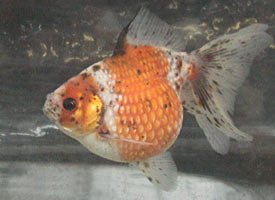 |
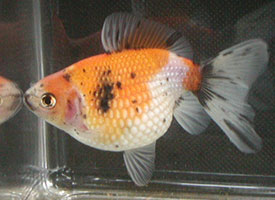
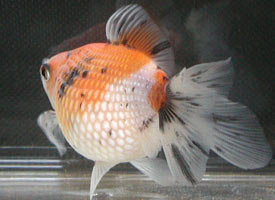
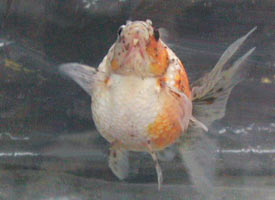
Two adult pearlscales shown at BAS 2005; the lower fish has a larger tail than for the standard.
 |
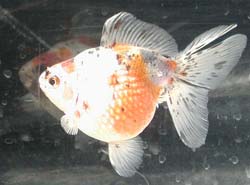 |
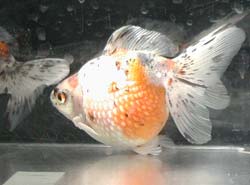
Mature adult, shown at BAS 2002, caught here in strong sunlight. All the above fish have the typical, orange-white colour of British pearlscales.
 |
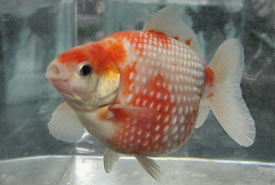 |
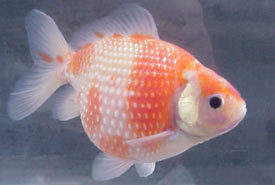
A very good example, shown at BAS 1999 (left) and BAS 2000 (right). Notice the similarity to the fantail in body size, contour and finnage.
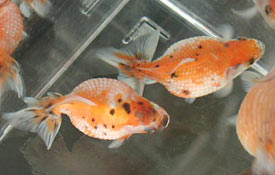
These fish are very typical of the pearlscales seen in UK, having an overall orange cast to the calico colouration and the typical very round body. They were shown at BAS 2000 as part of a breeder's team of four.
 |
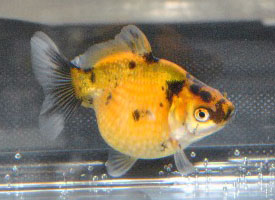 |
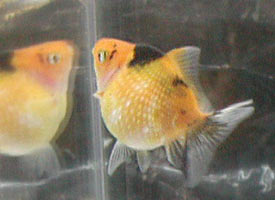
Yellow pearlscales; the fish on the left was shown at BAS 2005, and the right-hand fish was shown at the Nationwide Show 2016 (their photo).